




In a decision issued on 5 February 20261, the EUIPO Cancellation Division dismissed an application for a declaration of invalidity filed against a Community registered design for a backpack owned by Decathlon, thereby confirming the protection afforded under European design law, even in a sector crowded with earlier references.
This decision is of particular interest as it provides a clear reminder of the criteria governing the assessment of individual character, as well as the evidentiary requirements applicable to the disclosure of prior art, especially where such prior art originates from online sources.
The Italian company Gianto S.R.L. sought the invalidation of the European Union registered design No 002625202-0007, filed on 2 February 2015 for products in class 03-01, namely backpacks.
The applicant relied on Article 25(1)(b) of the European regulation, in conjunction with Articles 4, 5 and 6, arguing that the contested design failed to meet the requirements of both novelty and individual character, since it allegedly produced an overall impression similar to that created by several earlier designs disclosed to the public.
The Cancellation Division nevertheless rejected the application in its entirety and ordered the applicant to bear the costs of the proceedings, fixed at EUR 400, in accordance with the rules governing cost allocation in invalidity actions.
For reasons of procedural economy, the Cancellation Division first examined the issue of individual character, pursuant to Article 6 of the European regulation.
It recalled that a design has individual character where the overall impression it produces on the informed user differs from that produced by any design disclosed prior to the filing date.
The assessment follows a well-established methodology: identification of the relevant sector, determination of the informed user, evaluation of the designer’s degree of freedom, and a synthetic comparison of the overall impressions.
In the present case, the products concerned are backpacks. The informed user is therefore a person familiar with the designs available on the market, without being a designer or technical expert, but displaying a relatively high degree of attention.
The Division further emphasised that, in this sector, the designer’s freedom remains relatively broad. Although certain functional constraints exist, they do not lead to full aesthetic standardisation, meaning that significant formal choices remain available.
The applicant submitted several earlier references, including French designs published with the INPI, an earlier Community design, and pages extracted from the Amazon website.
The Division recalled that publication of a design by a national industrial property office constitutes valid disclosure within the meaning of Article 7 of the European regulation.
With regard to disclosures originating from the Internet, the decision stresses the strict evidentiary standards applicable: the evidence must include, within a single document, a clear representation of the product, a reliable publication date, and the precise source, without requiring further online research.
The Division nevertheless confirmed that online sales listings may constitute sufficient evidence where these conditions are satisfied, particularly where they establish that the product was offered for sale prior to the filing date of the contested design.
The Division recalled that the comparison of designs cannot be reduced to an analytical list of similarities and differences. It must remain global and based on the overall impression produced on the informed user.
It also noted that differences in colour are generally insufficient, on their own, to create a distinct overall impression, especially where the designer’s freedom is significant.
Of particular interest, the Division neutralised logos and distinctive signs appearing on the backpacks, in order to avoid any confusion between design protection and trade mark protection. The scope of protection must relate to the appearance and form of the product, not to its commercial identification.
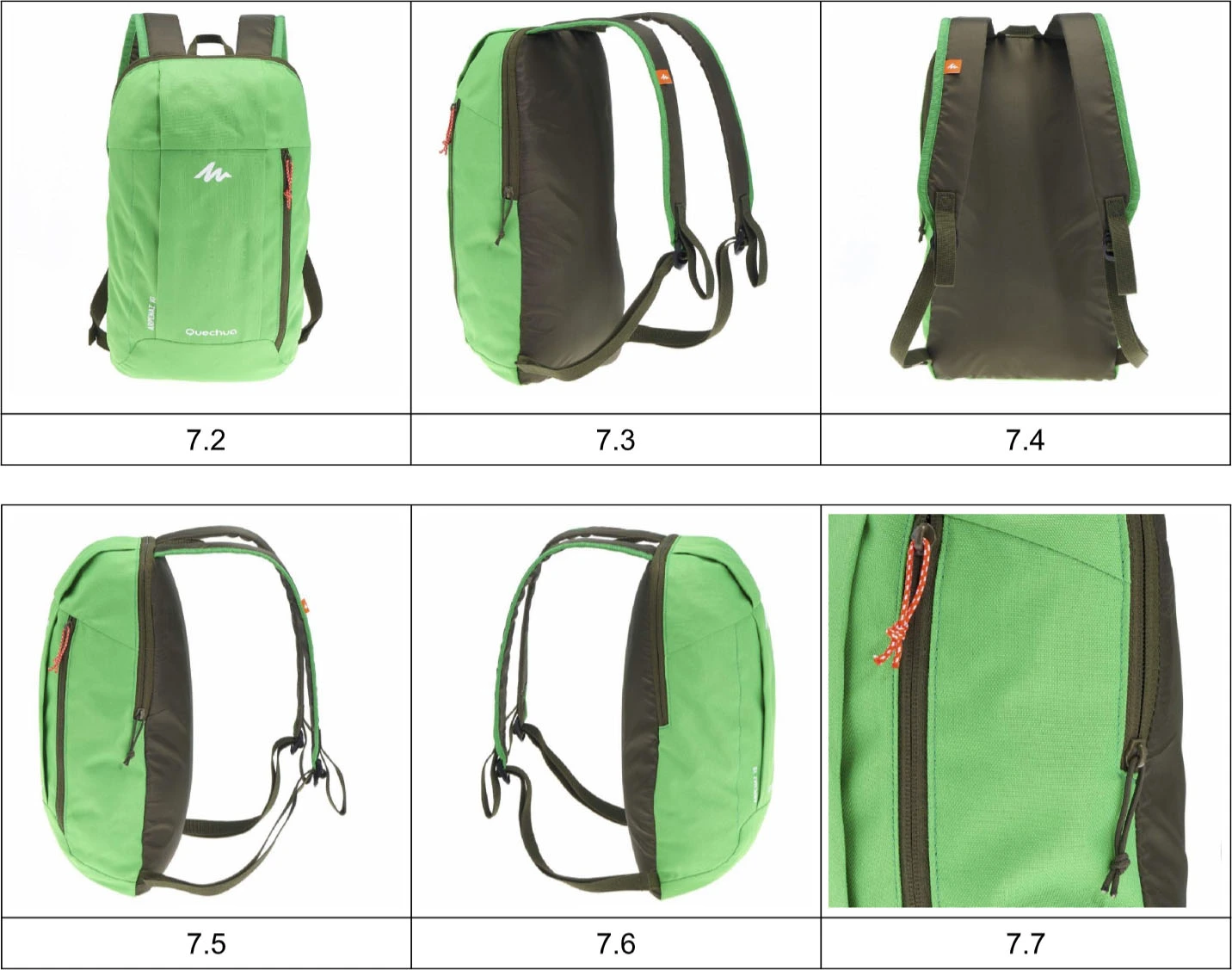
Applying these principles, the Division found that the contested design is characterised in particular by a rectangular shape with rounded corners, a slightly curved semi-elliptical profile, simple and linear shoulder straps, and a striking two-tone visual structure.
The earlier designs relied upon, although belonging to the same sector, displayed more pronounced volumes, more complex straps, additional fastening elements, visible technical appendices, or different zipper placements.
Accordingly, the overall impression perceived by the informed user clearly differs from that produced by the earlier references, meaning that the contested design possesses individual character within the meaning of Article 6.
Following this reasoning, the Division also dismissed the ground based on Article 5 of the European regulation.
It recalled that a design lacks novelty only where it is identical to an earlier design, differing only in insignificant details.
In the present case, the differences identified are immediately perceptible and exclude any identity. The invalidity application was therefore rejected in full.
This decision illustrates the EUIPO’s strict approach to the assessment of individual character, confirming that even in a saturated market such as backpacks, a design may benefit from effective protection where it produces a distinct overall impression on the informed user.
It also highlights the strategic importance of properly substantiating the disclosure of prior art, particularly for digital sources, and the need to maintain a clear conceptual boundary between design law and trade mark law.
1 Decision of the EUIPO Cancellation Division, 5 February 2026, Nullity No I 125 597
Photo par formulaire PxHere


