




By a decision dated 12 December 20251, the Second Board of Appeal of the EUIPO delivered a ruling of particular importance for owners of luxury trademarks faced with trademark filings in adjacent sectors such as finance, technology and digital services. Following an appeal lodged by LVMH Fragrance Brands, the Board of Appeal held that the figurative “4G” logo associated with the GIVENCHY House enjoys a high level of reputation within the European Union, at least in relation to perfumes, and applied Article 8(5) of the European Union Trade Mark Regulation (EUTMR) to refuse protection, in the European Union, to a similar figurative sign covering, inter alia, financial investment services relating to “luxury assets”.
Beyond the specific dispute, the decision clearly illustrates the logic of enhanced protection for reputed trademarks: where a link can be established in the mind of the relevant public between the signs, the EUIPO may lawfully prevent registrations covering dissimilar goods or services, in particular where such registrations amount to economic parasitism (free-riding).
To access the full text of the decision of the Second Board of Appeal of the EUIPO dated 12 December 2025 (R 1568/2024-2), please click on the link below.
The dispute arose from the designation of the European Union by an international registration covering a figurative sign designating, in particular:
LVMH Fragrance Brands filed an opposition relying, first, on Article 8(1)(b) EUTMR (likelihood of confusion) and, second, on Article 8(5) EUTMR (infringement of a trademark with a reputation), based in particular on the European Union figurative trademark corresponding to the “4G” logo of GIVENCHY.
At first instance, the Opposition Division partially upheld the opposition for certain goods but rejected it in respect of the Class 36 financial services, holding inter alia that those services were dissimilar to the earlier goods and services and that the reputation of the figurative sign had not been sufficiently established. The appeal focused precisely on that issue: whether the protection afforded by Article 8(5) EUTMR should extend to the disputed financial services.
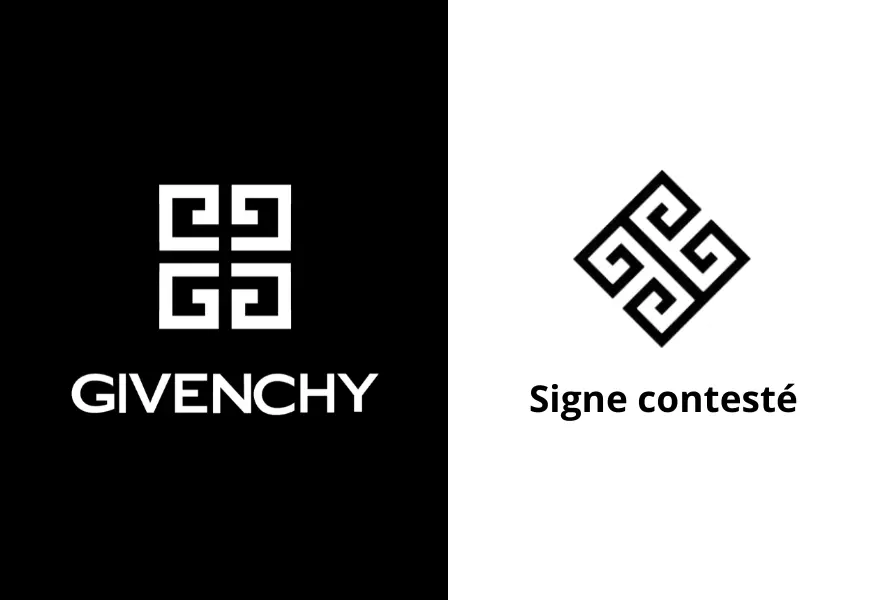
The Board of Appeal recalled that reputation, within the meaning of Article 8(5) EUTMR, must be assessed on the basis of a set of converging factors, including the duration and intensity of use, geographical scope, advertising investment and recognition by the relevant public.
From a procedural standpoint, the Board admitted evidence submitted for the first time on appeal, as it usefully supplemented the file and addressed the shortcomings identified at first instance, in particular regarding independent recognition and the quantitative reach of advertising campaigns.
On the merits, the Board concluded that the “4G” figurative device enjoys a high level of reputation in the European Union, at least in relation to perfumes. It relied in particular on:
The Board further emphasised that the public is systematically exposed to the figurative device alongside the word mark GIVENCHY, so that the reputation attached to the House naturally extends to its visual signature.
Having found a high degree of visual similarity between the purely figurative signs, both based on a comparable geometric arrangement, the Board of Appeal applied the criteria developed in EU case law for establishing a “link” in the mind of the relevant public.
Particular weight was given to the very definition of the contested services, which are expressly directed at investment in “luxury assets” and based on partnerships with brands. This sectoral positioning operates as a bridge between the fields concerned: investment in luxury assets necessarily involves close attention to brand value and reputation, which are key drivers of asset valuation.
In that context, the Board held that the relevant public, investors and informed consumers with an interest in the luxury sector, is particularly likely to establish a mental association between a sign closely resembling the emblem of a luxury house and financial services expressly positioned within that sector. The existence of a link, within the meaning of Article 8(5) EUTMR, was therefore established.
The Board of Appeal focused its analysis on the risk of unfair advantage, one of the three forms of injury referred to in Article 8(5) EUTMR. It held that adopting a sign closely resembling the “4G” logo for luxury-related investment services was likely to result in a transfer of image, encompassing prestige, trust, exclusivity and stability, values built by the GIVENCHY House through decades of substantial investment.
Such a transfer would confer an unjustified competitive advantage on the applicant, facilitating the marketing of its services without bearing the economic and promotional costs required to build an equivalent reputation. The Board further noted that the holder of the contested sign neither meaningfully challenged this analysis nor demonstrated the existence of any due cause capable of justifying the use of the sign.
Finding that all cumulative conditions of Article 8(5) EUTMR were met (reputation, similarity of the signs, establishment of a link, risk of unfair advantage and absence of due cause), the Board annulled the first-instance decision on this point and refused protection of the contested sign for the financial services in Class 36.
Conclusion
Through this decision, the EUIPO strongly reaffirms that iconic luxury trademarks benefit from extended protection, including against uses located at the intersection of finance, technology and investment. Where services are expressly linked to the luxury sector, proximity to reputed emblems may facilitate the establishment of a link and justify a finding of parasitism prohibited under EU trademark law.
For economic operators, the message is clear: any investment or asset-based project built around the luxury universe must, from the outset, incorporate a thorough assessment of reputational risks and indirect infringement of reputed trademarks.
1 EUIPO, Second Board of Appeal, 12 December 2025, R 1568/2024-2


